The checklist nobody trusts
There's a Notion page at most companies called something like *IT Offboarding, Do Not Delete*. It was written by someone who left 18 months ago. Nobody's updated it since, because updating it means admitting nobody trusts it, and nobody has a sprint to rebuild it.
This is the page someone opens on a Friday afternoon when an engineer's last day gets moved up without warning. 15 systems. SSH keys, database credentials, the Kubernetes cluster, the AWS console, a VPN client from 2022 that half the team forgot still exists. The page tells you where to look. It doesn't tell you what's missing, and whatever changed since someone wrote it is exactly what's missing. Onboarding is the same checklist run forward: a new hire needs the same 15 things, so someone spends Monday morning clicking through admin panels instead of doing actual work.
The real cost compounds instead of resetting with each cycle. Every manual step is a place someone assumes it's handled instead of knowing it is. Multiply that across a growing infrastructure footprint and the security posture is built on optimism.
Make identity the system of record
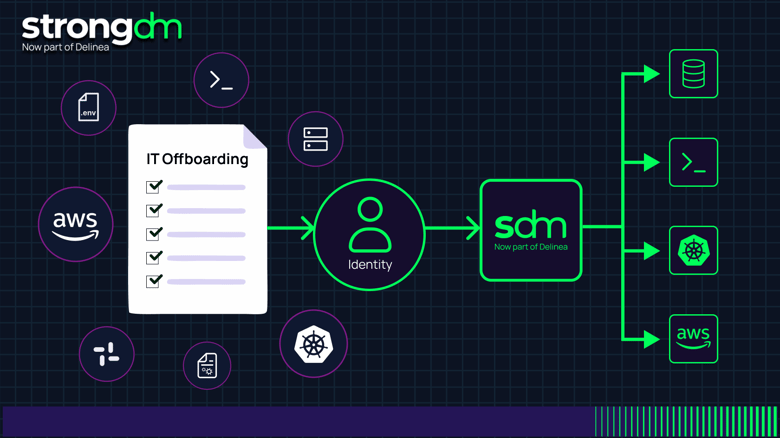
A runbook is a document. Documents don't revoke access, people do, and only when they remember. Tying access to identity itself, through the identity provider (IdP) already in place, fixes that. Add someone to the right group in Okta or Entra and access to servers, databases and clusters follows automatically, scoped to a role instead of hand-assigned resource by resource.
Remove them, and turning off one identity in the IdP turns off everything downstream. StrongDM turns onboarding and offboarding into an identity event instead of a checklist, because the IdP was always supposed to be the system of record. Most companies just never wired it tightly enough to trust it.
Infrastructure doesn’t wait for the checklist
Infrastructure grows on its own now, and none of it shows up on that Notion page, because nobody thinks to write it down. Someone spins up a database for a proof of concept, someone else stands up a cluster to test an idea and moves on, and none of it goes through an intake process because there wasn't one. That resource sits unmanaged until somebody happens to notice it.
StrongDM scans cloud environments for new compute, database and cluster resources and brings them under management with far less manual work than registering each one by hand, shrinking the gap between a resource existing and a resource being governed to something close to real time. It covers what StrongDM can broker, not a full asset inventory, and it won't surface every IAM role floating around an account.
Service accounts need a lifecycle too
Service accounts have the exact same onboarding and offboarding problem humans do, and almost nobody treats it that way. A CI/CD pipeline gets a token with more access than it needs because scoping it precisely takes an extra hour nobody has, and that token outlives the project. Nobody offboards a service account, because nobody tracked it as an employee-shaped thing to begin with.
A StrongDM service account created for that pipeline gets the same lifecycle discipline a human does, owned and shut off in one action when the job ends. That's real, and it's a gap most access tools skip. StrongDM governs the access identity uses. The underlying IAM role or Kubernetes service account still belongs to AWS, GCP, or the cluster's RBAC. A narrower claim than solving machine identity outright, and a more useful one for exactly that reason.
What building it yourself means
Building this in-house means writing and maintaining a separate integration for every system offboarding has to reach: one to revoke SSH certificates, another to drop database roles, another to pull someone out of Kubernetes RBAC, another to strip cloud console access. Four integrations minimum, before discovery even enters the picture, plus a service account policy someone actually enforces instead of writing down and forgetting.
It becomes a maintenance contract nobody signed, renewing every time a team adopts a new database engine or a cloud provider ships a resource type nobody's seen yet. Buying means someone else stays on the hook for keeping those integrations correct while the infrastructure changes every quarter, so the team doesn't have to.
What offboarding should look like
Go back to that Friday afternoon. The engineer's last day gets moved up, and instead of pulling up a stale Notion page and hoping to remember 15 systems, someone turns off one identity in the IdP. Any service accounts tied to that engineer get caught in the same motion. The database a contractor spun up last month is already inside the fence, found before anyone had to go looking. Nobody's checking a list and hoping. There's no list to check.
Why buy instead of build
That's the argument for buying this instead of building it. Doing it well in-house means standing up identity-tied revocation, cloud discovery and service account lifecycle management as three permanent engineering commitments, maintained forever by people who could be shipping product instead. StrongDM already is that plumbing. Buy it, and the checklist stops existing.