<img src="https://ws.zoominfo.com/pixel/6169bf9791429100154fc0a2" width="1" height="1" style="display: none;">

When AI Tools Get Standing Access: Lessons from the Vercel Breach

When AI Tools Get Standing Access: Lessons from the Vercel Breach

Contents

Secure Access Made Simple

Built for Security. Loved by Devs.

  • Free Trial — No Credit Card Needed
  • Full Access to All Features
  • Trusted by the Fortune 100, early startups, and everyone in between

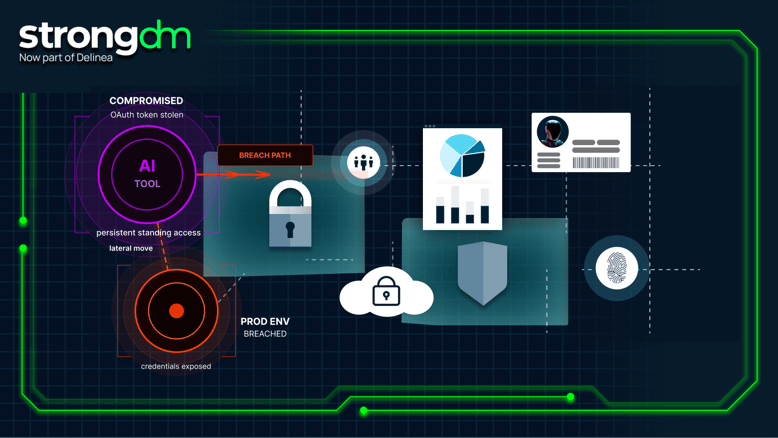
Vercel was the latest organization to come face-to-face with an OAuth attack in February 2026. The specifics of the Vercel breach will continue to unfold, but the pattern is already familiar. A third-party AI tool with persistent OAuth access becomes the entry point. From there, the attacker moves laterally through connected accounts and into environments where credentials are available. It's not a novel technique. It's the predictable result of how most organizations provision access for AI tooling today.

I want to be clear about something: this isn't a Vercel story. This is an everywhere story.


The access model is broken by design

Most organizations today are giving AI tools standing access to the same resources their employees use — and overlooking the same security controls. The OAuth grant is always live. The environments are always reachable. The credentials are always there. That's not a vulnerability in the traditional sense, it’s just how most organizations are built.

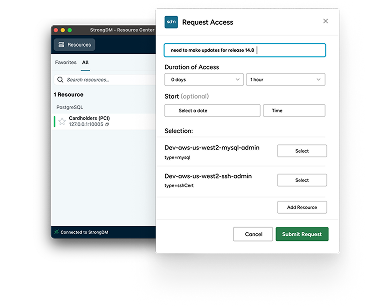
The fix is the same principle that's been reshaping human access governance: Just-in-Time. JIT means the OAuth grant only exists during an active, approved session. Access to production environments is time-bound and requires explicit policy evaluation. Even if an attacker compromises a tool in that chain, the window of exploitability shrinks from months to minutes.

And for AI tooling specifically, JIT gets even more powerful. As organizations adopt MCP-connected agents — tools like Claude, Codex, and Copilot that call external services through standardized protocols — JIT becomes enforceable at the tool level, not just the account level. Instead of an AI agent inheriting whatever access its connected identity has, each tool invocation can be individually evaluated, scoped, and time-limited.

It's not enough to govern who can use an AI tool. You need to govern what that tool can do, when it can do it, and for how long.

The identity no one is governing

Here's the part that should make every security team pause. In the Vercel breach, the compromised tool was operating as a non-human identity with OAuth access to a human's Google Workspace — an NHI with inherited human privileges.

Every AI tool, every MCP server, every agent integration is a non-human identity. They authenticate via tokens. They access resources. They can be compromised. But in most organizations, they're provisioned quickly, given broad access, and almost never audited with the same rigor as human accounts. The industry has been warning about this gap as AI agent adoption accelerates. The governance still hasn't caught up.

Classification isn't a solution

After a breach, the conversation often turns to secrets classification — did the right credentials get tagged as sensitive? But asking humans to correctly identify, tag, and classify every secret in every environment without error is a tall order.

The alternative is a credential injection model: secrets are injected by the gateway at connection time, used for the session, and never persist in the environment. There's nothing to exfiltrate because the credential never lands anywhere an attacker can reach. Whether something is marked sensitive becomes irrelevant because the credential was never sitting there to begin with.

What this means for your organization

AI tooling is accelerating. The access models around it need to accelerate too. The organizations that treat every AI integration as a real identity — with real governance, real audit trails, and real time-bound access — will be the ones that don't end up in the next breach headline.

The ones that don't? They're already building the next case study.

John Martinez

About the Author

, Technical Evangelist, has had a long 30+ year career in systems engineering and architecture, but has spent the last 13+ years working on the Cloud, and specifically, Cloud Security. He's currently the Technical Evangelist at StrongDM, taking the message of Zero Trust Privileged Access Management (PAM) to the world. As a practitioner, he architected and created cloud automation, DevOps, and security and compliance solutions at Netflix and Adobe. He worked closely with customers at Evident.io, where he was telling the world about how cloud security should be done at conferences, meetups and customer sessions. Before coming to StrongDM, he lead an innovations and solutions team at Palo Alto Networks, working across many of the company's security products.

💙 this post?
Then get all that StrongDM goodness, right in your inbox.

You May Also Like

Identity Was Built for Humans. AI Agents Change the Rules.
As AI agents take on actions once performed only by humans, traditional identity systems can’t provide clear delegation or accountability. StrongDM ID gives every agent a unique, verifiable identity linked to a human sponsor, ensuring organizations always know who authorized every action. In the next era of identity, authentication matters—but delegation defines trust.

The StrongDM Software Factory: Building Software with AI
The modern cloud is fast, dynamic, and complex. But legacy security tools can’t keep up. As containers and ephemeral resources constantly change, and access requests surge, security teams are left scrambling. Entitlements pile up, visibility fades, and audits become a nightmare.

StrongDM - UPAA
The End of “Verify Once, Trust Forever”
The modern cloud is fast, dynamic, and complex. But legacy security tools can’t keep up. As containers and ephemeral resources constantly change, and access requests surge, security teams are left scrambling. Entitlements pile up, visibility fades, and audits become a nightmare.

From Authentication to Authorization: The KPI Set Every Board Needs
StrongDM debuts in Gartner’s Magic Quadrant for PAM, redefining privileged access with real-time, policy-based authorization for modern cloud environments.
StrongDM Debuts in Gartner’s Magic Quadrant for Privileged Access Management
StrongDM debuts in Gartner’s Magic Quadrant for PAM, redefining privileged access with real-time, policy-based authorization for modern cloud environments.